


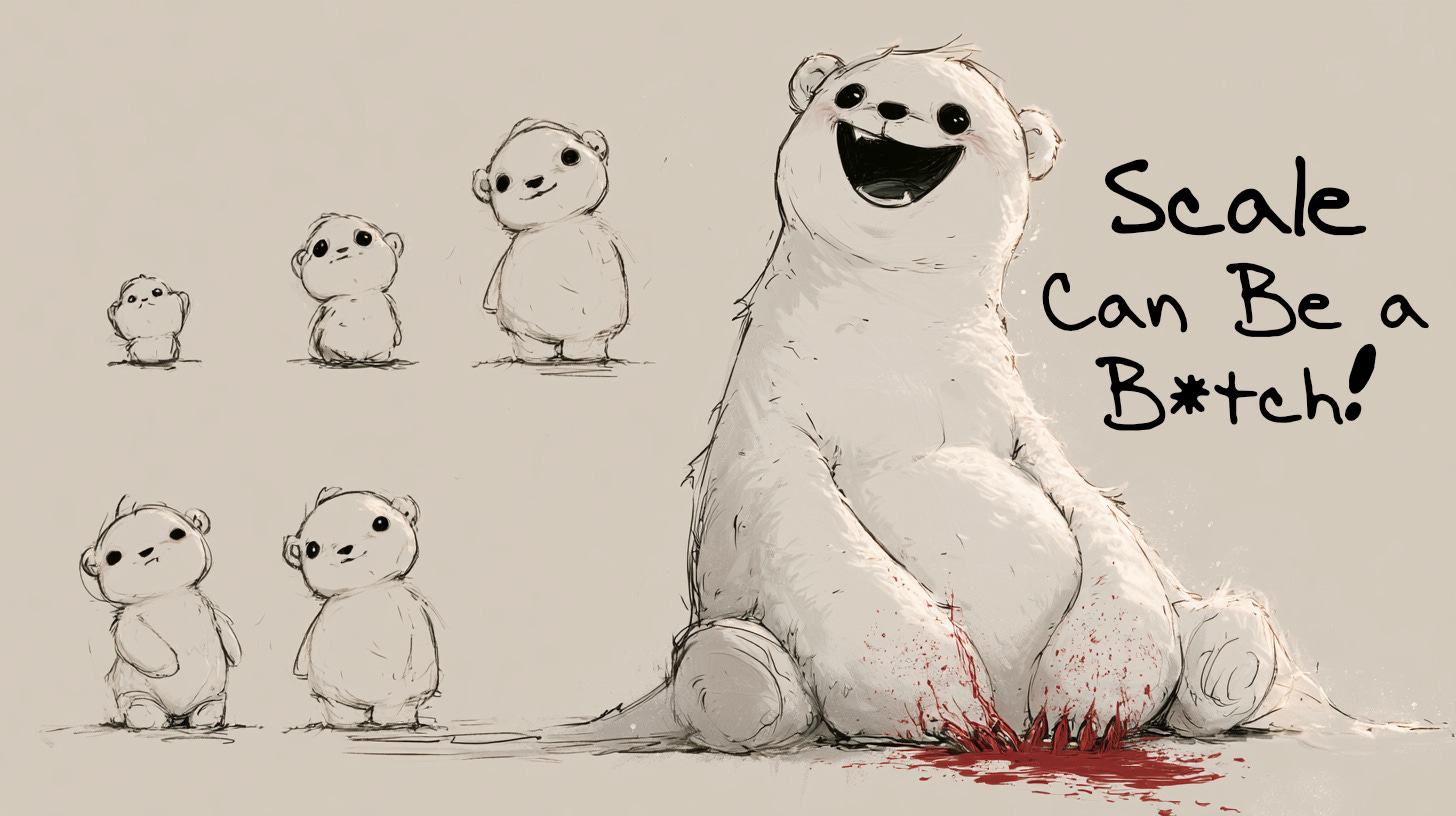
The stage: We grew our new organization, Luna Burn, from two people to 100+ in 5 weeks. Rapid growth teaches lessons that slow growth doesn’t.
Scaling is a bitch. Everyone says so. But why? Large corporations are notoriously big and slow, while small ones are nimble and creative. The reasons are structure and, surprisingly, statistics.
I’ve worked with companies from two to 2,000 people.
With two people, we were a rocket ship. When we needed a website, it took 15 minutes, and that was with one hand tied behind my back.
In a 2,000-person organization, a one-page website took six weeks. Six Weeks. I agonized. “How could this possibly take this long?”
The villain is scale. Scale makes jobs narrow. It requires new systems, and new communication. More bad things happen, and some of them are worse.
And when you’re growing as fast as Luna was growing, the problems hit fast and hard.
Everything, Everywhere, All at Once
Luna started with a single Signal chat. Everyone who wanted to be part of the effort was part of the chat, and it was growing by the hour.
Everyone was discussing everything:
What did we want our culture to be?
How were we going to get the money to run an event ourselves?
What departments were going to exist?
Would it be possible for us to rent the land?
This is the “big bang” moment in a startup. Everyone’s a generalist.
Organizations Grow, Jobs Shrink
Imagine that say you start with one person, Europa, handling both customer support and accounting. She handles everything. She knows every customer’s status. She handles both customer support and accounting, in one convenient person.
Then sales takes off. You’re up to 500 customers, and even Europa can’t track all that by herself. You hire more help—three more customer support people and two more accountants. Europa’s former single job of support+accounting is now a bundle of smaller jobs: support people who each handle a small part of the total support that needs to be done, and accountants who each handle several customer accounts.
The original doer, Europa, either becomes a single customer support rep or ends up managing support reps—a very different skill set than being a support rep herself.
As the business grows, the overall job grows. The bigger job requires more people. Each person gets a part of the overall job. This means that individual jobs are narrowing in scope, while increasing in depth.
Scale Demands New Systems: Enter Managers
As work gets bigger and jobs get smaller, you need to coordinate all those small jobs so they end up doing the scaled-up version of the big job they once were.
This is what a manager does. Europa, once the do-er, is now the only person who knows everything that needs to happen. So like it or not, she ends up needing to coordinate all of the narrow-but-deep new jobs.
Coordination Takes Communication
Narrow-but-deep jobs need to coordinate among themselves. When everyone is in one room discussing everything, it works. A customer service request comes in, and the support person turns to the accountant and asks, “Is this customer paid up on their support contract?” But the customer base grows. Eventually, there could be fifteen support reps and four accountants handling customers.
But when one of fifteen support reps gets a customer request, they need to make sure they’re not duplicating the work of some other rep. If a customer calls five times asking for a refund and gets five different customer service reps, you don’t want all five of them to separately issue a refund. This takes coordination within a function so everyone acts together.
One Week in and We Already Had Silos!
We hit scale limits almost immediately. As our signal chat grew, having a dozen conversations in one channel was driving us crazy. So we moved to Discord (another communication platform) and created channels for different topics. We had one for finance, one for art, one for graphic design, and so on. That way, each topic had one channel where they could have a coherent, single-themed conversation. We’d solved the problem of communicating within an area.
And that led to a whole new problem: the same issue would pop up in multiple channels, with multiple groups. At one point, three separate channels were discussing parking policies…and drawing opposite conclusions.
Our silos needed to coordinate between each other. Remember Europa’s fifteen customer support reps? They need to ask the four accountants if a caller has paid for support. What once happened in Europa’s head—checking with accounting—now needs to happen between two departments.
Yes, scale drives structural changes ... but wait, there’s more
To recap: when we were one chat with a few people, we didn’t need structure. Growth required separate groups to take on different aspects of the work. Within each group, jobs began to shrink. People needed to coordinate with each other. And as each group’s attention shifted towards working within the group, they lost touch with the other groups, driving the need for communication between what were fast becoming departments.
We put systems in place as fast as we could. Everything was ad hoc, since we had only four months before the event, we needed speed more then elegance. Nevertheless, regardless of our timeline, without managing the communication channels, there was no way we would pull this off.
But then statistics, glorious statistics, threw us an unexpected curveball. We’ll pick that up in the next installment.
If you would like a summary of the structural changes scale produces, you can download a copy at https://steverrobbins.com/scaleroadmap1